Showing posts with label social. Show all posts

Saturday, February 11, 2012

Should Mark Zuckerberg Think Twice About Establishing A Dynasty?


joaquin phoenix
Editor’s note: Charley Moore is a lawyer and the founder of online legal service Rocket Lawyer.
Congratulations Facebook! You have made history and changed the world. So, here are some thoughts from one of your biggest fans. Like the rest of the planet, I love Facebook and use it every day. So, there may never be a better time than now, when things are going really well, to add a dose of humility and perspective to the Facebook conversation.
Remember the movie Gladiator? Commodus, the bad son, murdered his aging father, Emperor Marcus Aurelius, preventing him from passing the empire down to his adopted good son, Maximus. Thus, instead of carrying on a centuries old tradition of merit-based succession, power passed to an unworthy blood relative and corruption followed.
What does this have to do with Facebook founder Mark Zuckerberg? Well, according to the $5 billion IPO filing, legal documents give him absolute control over the post-IPO company, even beyond the grave, just like a Roman emperor. That kind of power can have unintended consequences.
The story of Facebook’s spectacularly successful founder serves as a blueprint for others who hope to create corporate dynasties. Still, both he and those who seek to emulate him would be wise to take the counsel of history and establish at least a minimally representative corporate governance structure that includes one or more independent board members.
How did governance get to this point?
Facebook came of age after Google’s founders obtained super majority control at IPO, followed by LinkedIn, Groupon and Zynga (and more). In its early days, Sean Parker, a serial entrepreneur (Napster, Plaxo) who played an important early role as a confidante to Mr. Zuckerberg, helped convince him of the importance of founders maintaining control. As such, the Facebook founder has long dominated his board of directors, appointing three out of five seats.
Now, Facebook takes the founder-control trend to the extreme. By converting his shares into a class of super-voting stock at IPO, and designating Facebook as a “controlled company,” Zuckerberg will not only control 57.1% of the vote, but will also have the legal right to name 100% of the board of directors. He can also designate whomever he chooses as the successor to his corporate authority.
The unintended consequence of such absolute control may be the opposite of what Zuckerberg hopes. It isn’t a stretch to believe that he genuinely wants control in order to keep the business focused on the long-term social mission he described in his letter to shareholders, rather than the short-term gains often demanded by financial managers. What may happen instead is that the post-IPO business finds itself subject to whimsical decision-making and vulnerable to the inevitable securities lawsuits.
When founder-controlled companies sell shares to the public, they should plan for the possibility of the emperor at some point “having no clothes.” Eventually, even the best founders can lose their mojo, or appoint a successor who proves unequal to the task. This is when having independent views and fiduciaries can help shield the business from liability and guide it to a better place, even without legal control.
Of course, founder-controlled companies are often extraordinarily successful. In the United States, the founding family is an influential investor in more than one-third of the Standard & Poor’s 500 companies. Founding family owned companies tend to do well because of the long-term influence, interest, and investment of owners who are motivated by mission, not just by financial gain.
For example, Ford Motor Company has managed to sustain a profitable founding family business since Henry Ford incorporated it in 1903. Since 1956, the Ford family has wielded at least 40% of the company’s voting rights by setting up a system to ensure that only family members can own Class B stock. The family’s voting power includes the exclusive right to approve a merger, sale, or liquidation of the company.
In their desire to control but not stifle the business, the Fords enlisted qualified advisers, including original counsel Clifford Longley, investor Goldman Sachs, and independent directors. And it worked; Ford has survived multiple recessions, including the most recent economic downturn. Ford was the only American carmaker that didn’t need a government bailout.
Mr. Zuckerberg has so far made a different choice about the governance of Facebook. While appointing Sheryl Sandberg as a strong #2 has been brilliant, what will he do when she moves on? He and his heirs can exercise more corporate power post-IPO than when it was private. Opting to function as a “controlled company,” Facebook will be exempt from the customary stock exchange corporate governance rules that apply to the vast majority of public companies.
From the Facebook prospectus (S-1):
Because we qualify as a “controlled company” under the corporate governance rules for publicly-listed companies, we are not required to have a majority of our board of directors be independent, nor are we required to have a compensation committee or an independent nominating function.
Instead of a nominating committee for directors, all directors will be selected, removed and replaced by Mr. Zuckerberg, who is also imbued with the power to unilaterally choose a successor.
Mr. Zuckerberg has the ability to control the outcome of matters submitted to our stockholders for approval, including the election of directors and any merger, consolidation, or sale of all or substantially all of our assets … Additionally, in the event that Mr. Zuckerberg controls our company at the time of his death, control may be transferred to a person or entity that he designates as his successor.
While Larry Page, Sergey Brin, and Eric Schmidt at Google also maintain control, with
majority ownership and voting rights, the triumvirate approach has balanced governance, and none of their rights extends to the power to appoint and remove independent directors at will. The same goes for Reid Hoffman at LinkedIn, Andrew Mason at Groupon and Mark Pincus at Zynga.
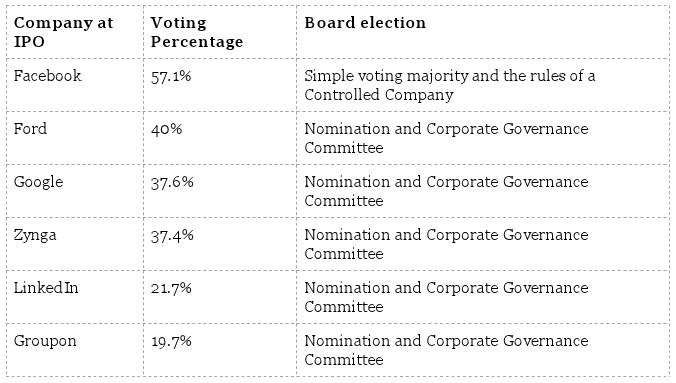
So, if you are a company founder, and you single-mindedly want to make your business a founder-controlled dynasty, Facebook is your blueprint. If, on the other hand, your goals include protecting the durability of the company you founded, even when you and your heirs may no longer project the visionary qualities that you do today, you should: 1) empower your company’s non-founder shareholders to elect at least 1 independent director; and 2) commit to a succession plan that is not hereditary by default.
Eva Arevuo also contributed to this article.

view original article here 

Saturday, January 28, 2012

ShoeBox App Now Integrates With Facebook Timeline, Lets You Add Photos To Years Past

ShoeBox App Now Integrates With Facebook Timeline, Lets You Add Photos To Years Past

Sarah currently works as a writer for TechCrunch, after having previously spent over three years at ReadWriteWeb. Prior to becoming a professional blogger, Sarah worked in I.T. across a number of industries, including banking, retail and software. ? Learn More
iPhone_0_3Phone_display ShoeBox, the mobile app that lets you scan old photos and post them online, is today announcing Facebook Timeline integration. Using the newly released version of the ShoeBox iOS application, users will be able to scan photographs of family and friends using their smartphone, tag users by name, and then share those photos to Facebook.
But here’s the really cool part: ShoeBox is one of the first Timeline-integrated apps that’s letting you post photos into the past. By that, I mean you can edit the date on your photo, and it will post to the correct place on your Facebook Timeline. Nifty!
I’ll admit to being a huge fan of what 1000memories is doing with its ShoeBox app, something which probably shows my age. I, like many of you (old people), didn’t “grow up” on Facebook. My childhood and young adulthood were captured by flash bulbs, printouts, and trips to the drug store to pick up prints – not smartphones and social networks. ShoeBox provides an easy way to get those old photos online so they can actually be shared and enjoyed.
In its first release back in October, the ShoeBox app allowed you to quickly snap a smartphone photo of a printed photo, crop, flatten and rotate the image, then fill in missing information, like that which might be scrawled on the back of the printout (where the photo was taken, who’s in it, what you were doing, date, etc.)
However, until today, none of that information actually appeared in the correct format to be useful on Facebook. It only worked to supplement on 1000memories’ own website, its social network of days past at 1000memories.com.
With today’s launch of the new iPhone application, things have changed. Now you can find and follow Facebook friends in the app and tag your Facebook friends by name so they’re alerted when the photos go online, a much-needed addition. You’re also now able to edit the date on the Facebook post to send it “back in time” to the date you specify.
Interestingly, this process of posting to the past could have been automated, but 1000memories says the team decided to use Facebook’s Photos API and not the OpenGraph API. Since the Photos API allows posts to appear on the Timeline in a different way – big and beautiful like Instagram now does – they decided to use it instead.
But the company is pushing Facebook to revive support for EXIF data for the ShoeBox app itself, which would allow users to automatically post pictures to the right spot while also still appearing in the attractive, larger format. EXIF (exchangeable image file format) is a standard format that contains a digital photo’s metadata information, – e.g., details about the camera’s make and model or the photo’s timestamp.
Facebook briefly supported EXIF data during Timeline’s tests, but stopped doing so because users were “freaked out” that Facebook knew when a photo was taken. Now Facebook is now more cautious about when and where it supports EXIF.
However, in a case like ShoeBox’s, using EXIF data would simplify the process of time-stamping these photos appropriately. Although the photo in question wouldn’t have been a digital photo to start, ShoeBox could still send Facebook EXIF data that relates to the scanned-in photo’s actual data of capture as indicated by a user’s caption (e.g., “Halloween 1985,” “beach trip 1997,” etc.).
The updated ShoeBox app is likely to be the first of many Timeline-integrated apps to come, now that the Facebook Timeline is mandatory. Although not everyone is thrilled about Facebook’s new look, when you can get past the knee-jerk “change is bad” mentality, there’s a pretty compelling use case here with the idea of filling out the missing Timeline dates with old photos. With Timeline, Facebook is no longer just a utility for social networking, it’s a digital representation of our lives. For it to be a truer reflection those lives, however, properly supporting the 4 trillion printed out photos in the world would be a good start.
The new version of the ShoeBox app is available here. (And yes, Android is coming).


1000memories is the best way to organize, share and discover the old photos and memories of your family and friends.
Learn more
View the original article here

Wednesday, January 18, 2012

Facebook’s New Timeline Apps Introduce New Actions

Facebook has partnered up with sixty different startups to add their “stories” to Facebook Timeline, through apps that span different verticals from Food, Fashion to Travel. Already apps like Fab.com, Foodspotting, Foodily, Ticketmaster, Pinterest,Rotten Tomatoes, Pose, Kobo, Gogobot, and TripAdvisor have signed on to share these stories which go beyond what we’re used to on Facebook.
“When we say anything we really mean anything,” Facebook Director of Product Management Carl Sjogreen said as he took the stage and announced that verbs like “knitting,” “shared” are now a part of Timeline story options.
The new app actions are basically a conceptual expansion of actions posted by apps like Spotify and the Washington Post, and use verbs and nouns that go beyond the non custom actions like “listen” “watch” and “read” to “bought,”"spot,”"pose,”"want,”"love” and “become an expert.”
“Up until now people have been only able to share photos they took on Foodspotting on Facebook, but there’s only a small majority of our users that share photos,” said Foodspotting co-founder Alexa Andrzejewski, “Now if you discover a dish, like Maple bacon latte you can “want” it on Foodspotting and your friends can discover it to. Because who would want to miss a Maple bacon latte? The greatest thing for us would be to be able to see a dish go viral on Facebook.”
“What we tried to build with Timeline apps was that each app should pick the actions verbs and nouns that best defines their use cases,” says Facebook engineer Mike Vernal.
Vernal tells me that Facebook won’t limit apps to which verbs they can use, and each app will have anywhere 2-10 verbs. The new verbs will show up in Ticker if an app doesn’t opt out of showing them there. Despite being open to unconventional verbs/actions like “nommed,” as of this time Facebook won’t support “dislike.”

source : techcrunch

Monday, January 16, 2012

Users Connect, Express and Record with Planner S – Social Diary for iOS


Planner S, a social diary application for iOS from Akaon makes its English debut soon. Originally conceived for a Korean language audience, Planner S has proven popular and well-suited to expansion. The application is a full featured calendar and planner, but Planner S goes beyond most scheduling utilities. With fully integrated social networking capabilities through Facebook, Twitter, and its own community, extensive personalization options, and the ability to customize the look and feel of each entry, Planner S embodies a dynamic new way to interact.

Planner S users can customize the appearance of the app on their iOS device, connect with the social networking sites of their choice, or keep their entries entirely private. Planner S has a beautiful interface which offers easy access to starting and customizing new entries at the user’s convenience. Entries can be edited, enhanced, and deleted after being saved. Each entry can be tailored to users’ exact needs, listing reminders, appointments, and tasks. Users can choose from a variety of visually appealing fonts, from sophisticated typeface to casual and cute handwriting options. Furthermore, entries can be accessorized individually with free and paid skins and virtual stickers from the in-app Planner S shop, tagged with users’ moods, and feature attached photos.

source : topiphonenews