Showing posts with label Android. Show all posts

Saturday, February 11, 2012

Should Mark Zuckerberg Think Twice About Establishing A Dynasty?


joaquin phoenix
Editor’s note: Charley Moore is a lawyer and the founder of online legal service Rocket Lawyer.
Congratulations Facebook! You have made history and changed the world. So, here are some thoughts from one of your biggest fans. Like the rest of the planet, I love Facebook and use it every day. So, there may never be a better time than now, when things are going really well, to add a dose of humility and perspective to the Facebook conversation.
Remember the movie Gladiator? Commodus, the bad son, murdered his aging father, Emperor Marcus Aurelius, preventing him from passing the empire down to his adopted good son, Maximus. Thus, instead of carrying on a centuries old tradition of merit-based succession, power passed to an unworthy blood relative and corruption followed.
What does this have to do with Facebook founder Mark Zuckerberg? Well, according to the $5 billion IPO filing, legal documents give him absolute control over the post-IPO company, even beyond the grave, just like a Roman emperor. That kind of power can have unintended consequences.
The story of Facebook’s spectacularly successful founder serves as a blueprint for others who hope to create corporate dynasties. Still, both he and those who seek to emulate him would be wise to take the counsel of history and establish at least a minimally representative corporate governance structure that includes one or more independent board members.
How did governance get to this point?
Facebook came of age after Google’s founders obtained super majority control at IPO, followed by LinkedIn, Groupon and Zynga (and more). In its early days, Sean Parker, a serial entrepreneur (Napster, Plaxo) who played an important early role as a confidante to Mr. Zuckerberg, helped convince him of the importance of founders maintaining control. As such, the Facebook founder has long dominated his board of directors, appointing three out of five seats.
Now, Facebook takes the founder-control trend to the extreme. By converting his shares into a class of super-voting stock at IPO, and designating Facebook as a “controlled company,” Zuckerberg will not only control 57.1% of the vote, but will also have the legal right to name 100% of the board of directors. He can also designate whomever he chooses as the successor to his corporate authority.
The unintended consequence of such absolute control may be the opposite of what Zuckerberg hopes. It isn’t a stretch to believe that he genuinely wants control in order to keep the business focused on the long-term social mission he described in his letter to shareholders, rather than the short-term gains often demanded by financial managers. What may happen instead is that the post-IPO business finds itself subject to whimsical decision-making and vulnerable to the inevitable securities lawsuits.
When founder-controlled companies sell shares to the public, they should plan for the possibility of the emperor at some point “having no clothes.” Eventually, even the best founders can lose their mojo, or appoint a successor who proves unequal to the task. This is when having independent views and fiduciaries can help shield the business from liability and guide it to a better place, even without legal control.
Of course, founder-controlled companies are often extraordinarily successful. In the United States, the founding family is an influential investor in more than one-third of the Standard & Poor’s 500 companies. Founding family owned companies tend to do well because of the long-term influence, interest, and investment of owners who are motivated by mission, not just by financial gain.
For example, Ford Motor Company has managed to sustain a profitable founding family business since Henry Ford incorporated it in 1903. Since 1956, the Ford family has wielded at least 40% of the company’s voting rights by setting up a system to ensure that only family members can own Class B stock. The family’s voting power includes the exclusive right to approve a merger, sale, or liquidation of the company.
In their desire to control but not stifle the business, the Fords enlisted qualified advisers, including original counsel Clifford Longley, investor Goldman Sachs, and independent directors. And it worked; Ford has survived multiple recessions, including the most recent economic downturn. Ford was the only American carmaker that didn’t need a government bailout.
Mr. Zuckerberg has so far made a different choice about the governance of Facebook. While appointing Sheryl Sandberg as a strong #2 has been brilliant, what will he do when she moves on? He and his heirs can exercise more corporate power post-IPO than when it was private. Opting to function as a “controlled company,” Facebook will be exempt from the customary stock exchange corporate governance rules that apply to the vast majority of public companies.
From the Facebook prospectus (S-1):
Because we qualify as a “controlled company” under the corporate governance rules for publicly-listed companies, we are not required to have a majority of our board of directors be independent, nor are we required to have a compensation committee or an independent nominating function.
Instead of a nominating committee for directors, all directors will be selected, removed and replaced by Mr. Zuckerberg, who is also imbued with the power to unilaterally choose a successor.
Mr. Zuckerberg has the ability to control the outcome of matters submitted to our stockholders for approval, including the election of directors and any merger, consolidation, or sale of all or substantially all of our assets … Additionally, in the event that Mr. Zuckerberg controls our company at the time of his death, control may be transferred to a person or entity that he designates as his successor.
While Larry Page, Sergey Brin, and Eric Schmidt at Google also maintain control, with
majority ownership and voting rights, the triumvirate approach has balanced governance, and none of their rights extends to the power to appoint and remove independent directors at will. The same goes for Reid Hoffman at LinkedIn, Andrew Mason at Groupon and Mark Pincus at Zynga.
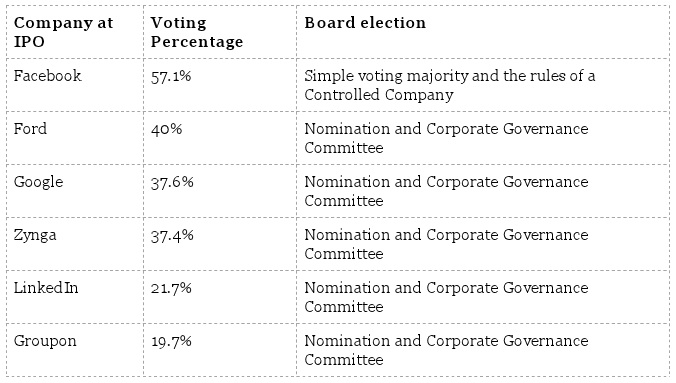
So, if you are a company founder, and you single-mindedly want to make your business a founder-controlled dynasty, Facebook is your blueprint. If, on the other hand, your goals include protecting the durability of the company you founded, even when you and your heirs may no longer project the visionary qualities that you do today, you should: 1) empower your company’s non-founder shareholders to elect at least 1 independent director; and 2) commit to a succession plan that is not hereditary by default.
Eva Arevuo also contributed to this article.

view original article here 

Friday, February 10, 2012

Foursquare Adds NFC Support To Its Android App

foursquare-android
In addition to the updated “Explore” feature that rolled out to Foursquare’s Android and iPhone applications this week, the social discovery service also added a special feature to its Android app that sort of flew under the radar: support for NFC.
NFC, or near field communication, allows devices to exchange data over short distances, typically with a wave or a tap. In Foursquare’s Android update, NFC support has been added for the app’s Venue, Lists and Me pages.
On Android, NFC support has been rebranded for marketing purposes, and is called “Android Beam.” The touch-to-share functionality lets NFC-enabled Android phones share information between each other, including contacts, web pages, and videos, for example. Any Android developer can also use the NFC APIs provided by the mobile operating system to add specialized NFC actions to their own apps.
With the Foursquare update, Android 4.0 users with NFC phones can now share their lists and the venues they’ve visited with a friend just by tapping phones. Users can now tap phones to initiate friend requests or tap their phone against an NFC tag or poster to check in.
Unfortunately, the functionality is currently limited to phones that have both an NFC chip built in and run Ice Cream Sandwich (Android 4.0). At this point, that means the Galaxy Nexus is pretty much your only option. (But that’s why you got that phone, right? You wanted to use the latest technology first. Well, here you go.)
The question remaining is why would Foursquare bother to push out an update that impacts such a small niche of the current Android user base?
In an Untether.tv interview with Holger Luedorf, VP of Mobile and International at Foursquare, he talked about why Foursquare added NFC to its app.
“The good news is the technology is already there,” he says. Plus,”going forward, some of the other platforms will be NFC-enabled.” (Please mean iOS!)
But it’s also about making the Android experience the best for its users, Luedorf said.
“The user experience is great. You just hold your phone against the tap [point]. The checkin screen automatically pops up with the right venue. You’re basically shaving very valuable seconds off the checkin process,” he says.
“We try to leverage the native experiences and APIs that are available through the platform as those usually drive the best user experience,” Luedorf continued. “We’re trying to leverage this because we feel that pinpointing someone down to a location through an NFC chip definitely has some value.”

view original article here

Thursday, February 9, 2012

Games Decreasing In Popularity On Android, Entertainment Apps On The Rise


Sarah currently works as a writer for TechCrunch, after having previously spent over three years at ReadWriteWeb. Prior to becoming a professional blogger, Sarah worked in I.T. across a number of industries, including banking, retail and software. ? Learn More
games-ios-android2 The mobile app ecosystem is growing so quickly – exponentially, even – that sometimes it’s hard to see the larger trends occurring in the space. To really gain insight, it helps to look back over a longer period of time, like a year for example, in order to take stock of the changes taking place.
To that end, I reached out to mobile app search company Chomp, who kindly obligated my curiousity by packaging together its first ever annual app search analytics report. The report digs into the data from Chomp’s 1 million app searches per month, to reveal trends in app prices, category share, top apps and more.
Note: The data below is conclusive for 2011, but Chomp’s Android app was only released in February. Chomp felt the graphs looked better starting from May, when data stabilized on both platforms.
To begin, Chomp took a deep dive in category share trends. The very first finding was a bit surprising. Chomp found that games are now seeing a decreasing number of downloads on Android. That’s interesting because we’ve come to think of the mobile gaming market as this booming space, which is defining itself as the top category driving mobile app download growth. But, based on Chomp’s data at least, this is only true for iOS. Over the course of the year, games became an increasingly large percentage of iTunes downloads, but have been decreasing on Android.
In December, for example, games were 36.1% of iTunes downloads and 22% of Android downloads.
So if not games, what’s growing in popularity on Android? I would have guessed Utilities but would have been wrong. It’s Entertainment apps. This includes apps like Netflix, Talking Tom, Crackle and Flixster, to give you an idea.

Meanwhile, on iTunes, music and fitness apps have been seeing increased popularity, and utilities are decreasing. Again, this goes contrary to popular belief that normal users (the non-technical/non-early adopters) are looking for more mobile tools – things that help them get a specific task done. Clearly, they’re also enjoying apps Spotify, Mog, RunKeeper and Nike Fitness, too.

In terms of app pricing, iTunes has seen purchase prices rise by 50% while Android prices have dropped. During December, the average iTunes app purchase price was $0.67 while the average Android app purchase price was only $0.09.

But here’s another interesting twist: the average purchase price for just paid apps is higher on Android ($3.17) than on iTunes ($2.41). This is due to iTunes’ large number of $0.99 downloads, however, which throw off the average.
It also has to be noted that Android sees a really low number of paid downloads (5%) compared with iTunes (22%), according to Chomp.

Finally, Chomp revealed its top 10 iTunes and Android apps of the year. These are different lists than what the app store itself would show, as they’re based on Chomp’s searches, not raw download numbers.
On Android, the top apps were:
PandoraFacebookLookout Mobile SecurityZedge RingtonesAdvanced Task KillerHandcent SMSDolphin BrowserThe Weather ChannelTuneInGasBuddyOn iOS, they were:
Angry BirdsFacebookDropboxIMDbPandoraAngry Birds SeasonsSoundHoundNetflixAngry Birds RioInstagram (also Apple’s pick for “app of the year”)These lists really help to showcase the differences between the two mobile platforms. Although Entertainment apps may be on the rise, Android users are still focused on tools and utilities, from mobile anti-virus programs and task killers, to things that will enhance or replace stock apps, like Handcent SMS or the Dolphin web browser. It will be interesting to see if, by next year, these trends will have changed at all, allowing the increasingly popular Entertainment-focused apps to emerge on the top Android apps list.
On iOS, there’s definitely more focus on having fun, with three versions of Angry Birds, music and photo apps, and Netflix, making the cut. The only remotely “utility-like” app on iOS’s like would be Dropbox.
Overall, the most interesting thing about this report was how it helped reframe some common misconceptions – that Android users only like utilities, for instance, or how cheap the paid Android apps are. They may be few and far between, but they’re not necessarily cheap.
Chomp’s full report includes its own Staff Picks section and a look into Chomp’s traffic search trends, too. (Contact the company if you’re in need of a copy). And may I just say: more data like this, please.

Chomp is the search engine that finds the apps you want. Chomp’s proprietary algorithm learns the functions and topics of apps, so you can search based on what apps do, not just what they’re called. Try searching for “puzzle games”, “kids games”, “expense trackers”, “tip calculators” or “chat” and start finding great apps. Chomp for iPhone was launched January 2010. Chomp is available via a free download in the iTunes App Store, Android Marketplace and on...
Learn more
View the original article here

Tuesday, February 7, 2012

Test Dropbox’s Ne Android App And Snag Some Extra Storage Space


Chris Velazco is a mobile enthusiast and writer who studied English and Marketing at Rutgers University. Once upon a time, he was the news intern for MobileCrunch, and in between posts, he worked in wireless sales at Best Buy. After graduating, he returned to the new TechCrunch to as a full-time mobile writer. He counts advertising, running, musical theater,... ? Learn More
android_splash Dropbox has no shortage of fans or users these days — their stellar wins at the Crunchies are proof of that — and now the cloud storage service is leaning on them to test an experimental new build of the Dropbox Android app.
While the thrill of being on the bleeding edge is probably enough for some people to take the plunge, the real meat of the experimental build comes in the form of the new auto upload feature for photos and videos. It’s pretty much exactly what the name implies: as soon as you snap a photo or take a video with your Android device, it automatically gets uploaded to your account. And in usual Dropbox fashion, it just works.
I was actually a bit surprised to see how well the feature worked right out of the gate. Once you breeze through the app’s new splash screens and start taking pictures, it takes only seconds for your shots to start trickling into your account. The 180MB file size limit has been given the axe too, so that Oscar-worthy film you’re putting together on your Galaxy S II should make the transition just fine too.
So what’s in it for you, aside from the ability to immediately shove your media into the cloud? More free storage, that’s what.
For every 500 MB of photos or videos that gets uploaded, another 500 MB will be added to your Dropbox account. Provided you stick with the process long enough, you’ll eventually walk away with 5GB more space than you had coming into it. Not bad Dropbox, not bad at all.
Dropbox just kicked off a similar campaign on their forums to test their slew of desktop clients, but motivated users shouldn’t bother trying to double-dip in attempt to snag 10 GB of storage. If you’re content to do a spot of beta testing in exchange for some nifty features, feel free to download the .apk right here.

View the original article here

Sunday, February 5, 2012

DoubleTwist updated again, no longer requires payment for podcast streaming

Android Central
Update: As doubleTwist's Monique Farantzos points out, streaming podcasts is now free, but you still have to upgrade to the premium version to download, subscribe and manage podcasts.
Original: Seems that the guys over at doubleTwist have been listening to the comments from the community. The application has been updated again about a week after they first brought in podcast streaming, to remove the necessity to pay for them.
A lot of you out there weren't too impressed by the charge imposed to unlock the podcast feature. Considering you can sync your subscriptions from iTunes for free if you already shelled out for the AirSync add-on, it seemed a little steep. All that is put to bed now though, as with this latest update podcasts are available for all -- which naturally includes the worlds greatest Android podcast. No word on whether or not they intend to refund anyone who did fork out, but we're guessing that not many of you parted with your cash. 
Aside from this, we also get a couple of improvements elsewhere in the app. Fixes come for video and podcast position saving, last.fm scrobbling and general bug fixes. We also get support for the Ice Cream Sandwich lockscreen which is always a welcome addition. You'll find the download links after the break.

Saturday, February 4, 2012

Ansca Mobile Accuses Partner PapayaMobile Of Copying Its Code

Sarah currently works as a writer for TechCrunch, after having previously spent over three years at ReadWriteWeb. Prior to becoming a professional blogger, Sarah worked in I.T. across a number of industries, including banking, retail and software. ? Learn More
ansca-logo-orange Ansca Mobile, the Palo Alto-based mobile development company and makers of the popular Corona SDK, is accusing its partner PapayaMobile of ripping off parts of its SDK  for use in PapayaMobile’s Social Game Engine. According to Ansca Mobile COO David Rangel, his company recently discovered that Papaya’s engine is what he calls a “blatant copy” of some aspects of the Corona SDK.
In addition, says Rangel, some of PapayaMobile’s syntax and sample code is identical to Ansca’s, and the company is using graphic assets it took from the code on the PapayaMobile website.
The code PapayaMobile is being accused of copying is available here in the Corona SDK, a free download from the Ansca Mobile website.
You can also see that the image above the “Physics Demo” on this page of PapayaMobile’s website (as of the time of writing) is an image from Ansca’s sample code packages. It even has the Ansca logo.

If you were to download the sample code, you would see that it’s very similar to Ansca’s code, Rangel says. What this means, he explains, is that they “clearly based how their physics engine works very closely on ours.”
Ansca hasn’t yet settled on legal action, but Rangel says “we do think it’s egregious and is worth calling out.”
The situation is a strange one because Ansca and PapayaMobile announced an official partnership back in August which allowed PapayaMobile’s SDK to be integrated into Corona. This made it easier for mobile game developers to add social elements to their games.
Stranger still are the accusations that Ansca reached out to PapayaMobile to try and resolve the situation, but never heard back. PapayaMobile, meanwhile, claims to not have heard of these accusations until this morning, when we contacted them for comment.
As of right now, PapayaMobile doesn’t have an official comment on the situation. The company says it needs more time to research matter in order determine what’s really going on. They’ll let us know when they have more information.
Note: We’ll update this post with that info, when it becomes available.

Ansca empowers developers of all backgrounds to create graphically rich games and apps for iPhone, iPad, and Android. With an award-winning team of software veterans and a proven track-record of shipping industry-standard mobile and desktop software, They are committed to creating innovative mobile products that allows everyone to unlock their imagination.
Learn more Android and iOS’s leading social gaming network, offering a full suite of social gaming features, diverse set of monetization tools, and the fastest 2D OpenGL Social Game Engine. Our products allow developers to maximize the return on investment of their games, while virally marketing to the 30+ million active Papayans to instantly increase user acquisition. All of PapayaMobile’s SDKs and Game Engine products are open and free to use, serving as a one-stop-shop for all game developer needs. Our...
Learn more
 view original article here

Test Dropbox’s New Android App And Snag Some Extra Storage Space

Chris Velazco is a mobile enthusiast and writer who studied English and Marketing at Rutgers University. Once upon a time, he was the news intern for MobileCrunch, and in between posts, he worked in wireless sales at Best Buy. After graduating, he returned to the new TechCrunch to as a full-time mobile writer. He counts advertising, running, musical theater,... ? Learn More
android_splash Dropbox has no shortage of fans or users these days — their stellar wins at the Crunchies are proof of that — and now the cloud storage service is leaning on them to test an experimental new build of the Dropbox Android app.
While the thrill of being on the bleeding edge is probably enough for some people to take the plunge, the real meat of the experimental build comes in the form of the new auto upload feature for photos and videos. It’s pretty much exactly what the name implies: as soon as you snap a photo or take a video with your Android device, it automatically gets uploaded to your account. And in usual Dropbox fashion, it just works.
I was actually a bit surprised to see how well the feature worked right out of the gate. Once you breeze through the app’s new splash screens and start taking pictures, it takes only seconds for your shots to start trickling into your account. The 180MB file size limit has been given the axe too, so that Oscar-worthy film you’re putting together on your Galaxy S II should make the transition just fine too.
So what’s in it for you, aside from the ability to immediately shove your media into the cloud? More free storage, that’s what.
For every 500 MB of photos or videos that gets uploaded, another 500 MB will be added to your Dropbox account. Provided you stick with the process long enough, you’ll eventually walk away with 5GB more space than you had coming into it. Not bad Dropbox, not bad at all.
Dropbox just kicked off a similar campaign on their forums to test their slew of desktop clients, but motivated users shouldn’t bother trying to double-dip in attempt to snag 10 GB of storage. If you’re content to do a spot of beta testing in exchange for some nifty features, feel free to download the .apk right here.

View the original article here

Thursday, February 2, 2012

Android Dominates Moolah Media’s Mobile Ads


View the original article here

Games Decreasing In Popularity On Android, Entertainment Apps On The Rise

Games Decreasing In Popularity On Android, Entertainment Apps On The Rise

Sarah currently works as a writer for TechCrunch, after having previously spent over three years at ReadWriteWeb. Prior to becoming a professional blogger, Sarah worked in I.T. across a number of industries, including banking, retail and software. ? Learn More
games-ios-android2 The mobile app ecosystem is growing so quickly – exponentially, even – that sometimes it’s hard to see the larger trends occurring in the space. To really gain insight, it helps to look back over a longer period of time, like a year for example, in order to take stock of the changes taking place.
To that end, I reached out to mobile app search company Chomp, who kindly obligated my curiousity by packaging together its first ever annual app search analytics report. The report digs into the data from Chomp’s 1 million app searches per month, to reveal trends in app prices, category share, top apps and more.
Note: The data below is conclusive for 2011, but Chomp’s Android app was only released in February. Chomp felt the graphs looked better starting from May, when data stabilized on both platforms.
To begin, Chomp took a deep dive in category share trends. The very first finding was a bit surprising. Chomp found that games are now seeing a decreasing number of downloads on Android. That’s interesting because we’ve come to think of the mobile gaming market as this booming space, which is defining itself as the top category driving mobile app download growth. But, based on Chomp’s data at least, this is only true for iOS. Over the course of the year, games became an increasingly large percentage of iTunes downloads, but have been decreasing on Android.
In December, for example, games were 36.1% of iTunes downloads and 22% of Android downloads.
So if not games, what’s growing in popularity on Android? I would have guessed Utilities but would have been wrong. It’s Entertainment apps. This includes apps like Netflix, Talking Tom, Crackle and Flixster, to give you an idea.

Meanwhile, on iTunes, music and fitness apps have been seeing increased popularity, and utilities are decreasing. Again, this goes contrary to popular belief that normal users (the non-technical/non-early adopters) are looking for more mobile tools – things that help them get a specific task done. Clearly, they’re also enjoying apps Spotify, Mog, RunKeeper and Nike Fitness, too.

In terms of app pricing, iTunes has seen purchase prices rise by 50% while Android prices have dropped. During December, the average iTunes app purchase price was $0.67 while the average Android app purchase price was only $0.09.

But here’s another interesting twist: the average purchase price for just paid apps is higher on Android ($3.17) than on iTunes ($2.41). This is due to iTunes’ large number of $0.99 downloads, however, which throw off the average.
It also has to be noted that Android sees a really low number of paid downloads (5%) compared with iTunes (22%), according to Chomp.

Finally, Chomp revealed its top 10 iTunes and Android apps of the year. These are different lists than what the app store itself would show, as they’re based on Chomp’s searches, not raw download numbers.
On Android, the top apps were:
PandoraFacebookLookout Mobile SecurityZedge RingtonesAdvanced Task KillerHandcent SMSDolphin BrowserThe Weather ChannelTuneInGasBuddyOn iOS, they were:
Angry BirdsFacebookDropboxIMDbPandoraAngry Birds SeasonsSoundHoundNetflixAngry Birds RioInstagram (also Apple’s pick for “app of the year”)These lists really help to showcase the differences between the two mobile platforms. Although Entertainment apps may be on the rise, Android users are still focused on tools and utilities, from mobile anti-virus programs and task killers, to things that will enhance or replace stock apps, like Handcent SMS or the Dolphin web browser. It will be interesting to see if, by next year, these trends will have changed at all, allowing the increasingly popular Entertainment-focused apps to emerge on the top Android apps list.
On iOS, there’s definitely more focus on having fun, with three versions of Angry Birds, music and photo apps, and Netflix, making the cut. The only remotely “utility-like” app on iOS’s like would be Dropbox.
Overall, the most interesting thing about this report was how it helped reframe some common misconceptions – that Android users only like utilities, for instance, or how cheap the paid Android apps are. They may be few and far between, but they’re not necessarily cheap.
Chomp’s full report includes its own Staff Picks section and a look into Chomp’s traffic search trends, too. (Contact the company if you’re in need of a copy). And may I just say: more data like this, please.

Chomp is the search engine that finds the apps you want. Chomp’s proprietary algorithm learns the functions and topics of apps, so you can search based on what apps do, not just what they’re called. Try searching for “puzzle games”, “kids games”, “expense trackers”, “tip calculators” or “chat” and start finding great apps. Chomp for iPhone was launched January 2010. Chomp is available via a free download in the iTunes App Store, Android Marketplace and on...
Learn more
View the original article here

Monday, January 30, 2012

What Happens When Apps Go On Sale?: Revenue Up 22% On iPhone, 29% On Android

What Happens When Apps Go On Sale?: Revenue Up 22% On iPhone, 29% On Android

Sarah currently works as a writer for TechCrunch, after having previously spent over three years at ReadWriteWeb. Prior to becoming a professional blogger, Sarah worked in I.T. across a number of industries, including banking, retail and software. ? Learn More
DistimoCorporate300px In a new research report from Distimo, the app store analytics provider examined two different ways that allow mobile developers to get a bump in both their download numbers and revenue. One way, which is within the developers’ control, is putting the app on sale. Within the first day, iPhone developers see an average increase of 41% in revenue using this method, and see revenue increases of 22% by the sale’s end. Android apps, however, rose just 7% on day one, but closed out the sale with higher percentage gains than either iPhone or iPad.
The second method Distimo looked into is getting the app featured in the app store. This is up to the app store’s operator, like Google or Apple, of course. (We’ll examine Distimo’s findings on featured apps in a subsequent post).
When a developer decides to put an application on sale, there’s a delicate balance that has to be achieved. The sale price has to be low enough to encourage more downloads, obviously, but it also needs to be low enough that it encourages enough download volume to make up for the lost revenue.
To examine what happens during when apps go on sale, Distimo examined the 100 top grossing apps in the iPhone App Atore, iPad App Store and Android Market. On the first day of the sale, the average revenue increase by +41% in the iPhone App Store,  and by 15 days in, was up by +22%. On the iPad App Store, the day one effect was even greater: up +52% on day one and up +19% by day 15.

But the boost in the Android Market was the largest of all, although this couldn’t immediately be seen. By day one, revenue was just +7% on average, but by day 15, it was up +29%. These are percentage increases, though – not dollar amounts.
Keep in mind, too, that these gains are averages. Not all developers were so lucky. In looking closer at the numbers, Distimo found that 44% of iPhone apps lost revenue during the sale, with 23% seeing a decline in revenue by more than 20%. This is why the sale price setting is key to maximizing the gains. For example, a discount of a dollar on a $7.99 app lowers the revenue, but a discount of $3 increased revenue by 131%. In general, the tipping point occurred when the app’s price was cut in half or the app was offered in Tier 1 ($0.99) or Tier 2 ($1.99).
The graph below shows what happens when prices were cut by 40%, 50%, 60%, 70% or 80%. The conclusion here is that it can pay to put an app on sale, but to actually earn more revenue, you have to make a significant price cut.

This all begs the question, then: what price should a developer ask? There isn’t a simple ratio to use. The right price depends a lot on what kind of application it is, where it’s sold, what category it falls into and its overall complexity. Simple apps that are easy to make (and copy) are priced lower. You can see the variations by revenue, category and app store here:

Since this is a lot of info to take in, we’ll look at Distimo’s findings related to apps being featured in the app store in a separate post. You can find the full report here.

We know app stores. Distimo was founded to solve the challenges created by a widely fragmented app store marketplace filled with equally fragmented information and statistics. Distimo was launched shortly after the introduction of the first app store. App stores have clearly shown since that time that they are the way forward for content distribution. The app store model offers an enormous opportunity for developers to get their content out and dramatically improves content discovery by consumers. However, the mobile market...
Learn more
View the original article here

Friday, January 27, 2012

AT&T Set Sales Records For Both iPhone And Android Devices In Q4 2011

AT&T Set Sales Records For Both iPhone And Android Devices In Q4 2011

Robin Wauters currently works as a staff writer for TechCrunch and lead editor of Virtualization.com. Aside from his professional blogging activities, he’s an entrepreneur, event organizer, occasional board adviser and angel investor but most importantly an all-round startup champion. Wauters lives and works in Belgium, a tiny country in Europe. He can often be found working from his home or... ? Learn More
att AT&T this morning released its earnings for the fourth quarter of 2011. Consolidated revenues clocked in at $32.5 billion, up 3.6 percent compared to the year-earlier quarter. They recorded a huge net loss for Q4 2011: $6.7 billion, or $1.12 per diluted share.
Zooming in on smartphone sales, it’s worth noting that AT&T delivered its best-ever quarter to date, hands down.
In the fourth quarter of 2011, the company says it sold 9.4 million smartphones, nearly double the number sold in the third quarter and 50 percent more than the previous quarterly record.
This also led to 19.4 percent growth in wireless data revenues, the company said.
During the quarter, more than 7.6 million iPhones were activated, the “majority of which” were iPhone 4S, and AT&T says more than twice as many Android smartphones were sold last quarter compared to the fourth quarter of 2010. AT&T also said it sold 311,000 tablets in Q4 2011.

AT&T is the largest provider of both local and long distance telephone services, and DSL Internet access in the United States and the second largest wireless service provider in the United States.
Learn more
View the original article here

Wednesday, January 25, 2012

Chart: Android Is Catching Up To iOS In Mobile Video Views

Chart: Android Is Catching Up To iOS In Mobile Video Views

Erick Schonfeld is the Editor in Chief of TechCrunch. He oversees the editorial content of the site, helps to program the Disrupt conferences and CrunchUps, produces TCTV shows, and writes daily for the blog. He is also the father of three adorable children. He joined TechCrunch as Co-Editor in 2007, and helped take it from a popular... ? Learn More
mobile video chart encoding With 250 million Android devices out there, growing by more than 700,000 activations a day, a lot of mobile video is watched on Android cell phones and tablets. It is not quite as much yet as on Apple iOS devices but it is catching up fast.
A year ago in January, 2011, Apple dominated mobile video views, with iOS devices accounting for 87 percent of all mobile views, according to data from video encoding and short-url service Vid.ly. Android had a scant 5 percent. By December, 2011, Android’s share of mobile video watching grew to 32 percent, while Apple’s shrank to 52 percent.
Vid.ly is a service run by Encoding.com, which launched a year ago. The data is only from its service, but is from a large enough sample (more than 1 million video views a month for each platform) that it should be representative.

Android is a software platform for mobile devices based on the Linux operating system and developed by Google and the Open Handset Alliance. It allows developers to write managed code in Java that utilizes Google-developed software libraries, but does not support programs developed in native code. The unveiling of the Android platform on 5 November 2007 was announced with the founding of the Open Handset Alliance, a consortium of 34 hardware, software and telecom companies devoted to advancing open standards...
Learn more iOS is Apple’s operating system for their mobile devices. It debuted in 2007 with the release of the first iPhone, but has since been extended for use with the iPod touch, iPad, and Apple TV. iOS’ user interface relies on users’ direct manipulation of the product screen with multi-touch gestures, including swipes, pinches, taps, and reverse pinches.
Learn more Vidly, formerly known as TwitVid (or Twitvid.io), wants to be the easiest way to share video on the web. While one aspect is sharing videos on Twitter, the focus is on other social networks as well, with a key focus on the various mobile platforms.
Learn more Encoding.com, the world’s largest video encoding service, powers video transcoding for 1,500+ companies, including leading brands across media and entertainment, eLearning, retail, telecommunications, lifestyle and advertising. Blending an affordable SaaS model with sophisticated integrations on the AWS and Rackspace cloud computing platforms, Encoding.com enables publishers and developers to instantly scale without expensive video infrastructure investments. Encoding.com supports ALL popular web and mobile formats utilizing Encoding Intelligenceâ„¢ to accelerate processing and optimize display on any device. ...
Learn more
View the original article here

Sunday, January 22, 2012

Galaxy Nexus ROM Review: Codename Android v1.1.4

The Background

When I first bought my Galaxy Nexus I was thoroughly impressed. In fact you can read both mine as well as other authors’ 24 hour and 48 hour initial thoughts on the matter. As I used the phone more and more I have found that the one aspect of the phone that really got me down was the battery life. Even with the extended battery I still had to plug the device in about half way through my day just to make it through the rest of my work day and I’m not even in a 4G area.

I went through the process of rooting the device, perma-installing Clockwork and backing up my stock ROM and that was it. I still suffered through horrid battery life. While yes Samsung does pledge to bring better battery life and an extended battery helps, I was quite sad at the matter.

Well it wasn’t long after the release of the Android 4.0.3 images that ROMS were popping up. While I was hesitant to flash anything to my device, not because I was scared of ROMing such a ROM friendly phone but because I love stock Ice Cream Sandwich, the battery life was a big issue. I experimented with a few ROMs, GummyNex, AXI0M 2.3 and Tranquil Ice v6 to name a few and I found that while battery life was better, it still wasn’t good enough for my liking.

The ROM of Choice

While searching through various kernel and ROM lists my editor stumbled upon Codename Android 1.1.1. That was the latest version at the time but as I am writing this I am on version 1.1.4. I spent some time reading the forum for various bugs and issues and I found that this one had the least amount of problems. The ROM boasts that everything you want in a ROM is in this one ROM. As the developer puts it:

     ”Codename Android is a fully open source rom that focuses on speed, usability, and getting every feature that we can get CRAMMED in there”

After downloading the ROM, the Gapps (1.14.2012) and at the time, the Franco Kernel I was ready to flash and install.

The Set-Up

As usual I wiped all data and factory settings, plus the cache and Dalvik cache and flashed the ROM followed by the Gapps package, and finally the Franco Kernel. Sadly at the time I hadn’t backed up any of my apps with Titanium Backup so I had to reinstall all my apps. After that I spent some time getting all my screens back to the way I wanted. Surprisingly, even with downloading all my apps I only used about a quarter of the battery.

It took some time to get all my accounts set up and what not but the ROM adds some amazing features.

A while after set up, Yes it was -11 out.

The Features

The ROM adds some nice features to an already impressive OS. There are now new options in the settings menu that allow you to customize the lockscreen, adding more shortcuts and so on, all the way up to the addition of well, additional softkey mods (see picture below). You can turn off the persistent search bar for extra screen space; add up to 7 total home screens, and even the ability to resize widgets.

Battery Bar and Custom Softkeys

It also adds the ability to customize the pulse notification light without a special app like Lightflow. You can change colors duration, etc. I love the ability to add toggle switches in the notification bar, even the LTE toggle. You can customize which toggles you want too. This added with the performance and battery life of the ROM coupled with the Franco Kernel creates an over all awesome experience.

Custom Options

The Performance and Battery Life

 The amazing thing about this ROM is everything seems quicker. I don’t know if you folks noticed but there is some lag time between selecting the camera on the lock screen and it loading up. This is gone, much to everyone’s relief. Menus were snappier and navigating just seemed quicker. Transitioning from one page to the next in the app drawer was smoother as well. NFC works as well, and Google Wallet comes pre-installed with no need for fancy hacking or modding skills.

Battery life on the ROM with the Franco Kernel installed was quite phenomenal. While I don’t have 4G in my area, we’ll get to the 4G later, I was able to get over 16 hours worth of battery life with heavy use on the extended battery (see below). By heavy use I mean six 20 plus minute phone calls, constant emailing, texting, and Internet browsing, plus Angry Birds and Plants vs. Zombies gaming.  That amount of usage would have me plugged in and charging after about 6 hours on Stock ICS. The 16+ hours of battery life has become a daily occurrence and I can safely say that I can go through an entire day without worrying about bringing an extra battery or charger along with me everywhere I go.

Not bad for a day’s worth, with juice to spare

Now I know I am not in a 4G area and for those of you that are, this isn’t a fair representation. However my editor Stacy Bruce has the same ROM installed. He has the Faux123 Tuna Kernel installed because he found that it had better battery life on a 4G connection than the Franco Kernel did. In fact you can see from the image below that he was able to get over a day’s worth of use with mild use. According to him mild use includes “a bunch of emails, couple texts, 2 downloads, 8 pictures (no flash), 20 min of Shine Runner and about 20min of web browsing.”

Stacy was able to suck every last bit of juice out of his battery.

The Conclusion

This ROM has been amazing. I installed it over a week ago and I haven’t looked back. Battery life is a huge driving force for me in choosing and keeping a ROM and part of it is thanks to the kernels flashed. Codename Android keeps the stock appeal but adds some much needed functionality and customization to the Galaxy Nexus. Coupled with battery life you have before you a super amazing ROM.

For me this ROM is as close to stock as you can get but with the option to throw in as many goodies and customizations you can to your heart’s delight. If you want a ROM with really good battery life I would recommend this ROM whole-heartedly. While other ROMS with the same kernels probably have the same performance, the ability to customize this ROM without the need to flash various mods makes this ROM complete. You will find below a link to the ROM, and both kernels for your flashing pleasure and if you haven’t rooted your Galaxy Nexus you can do so by going
source : talkandroid